
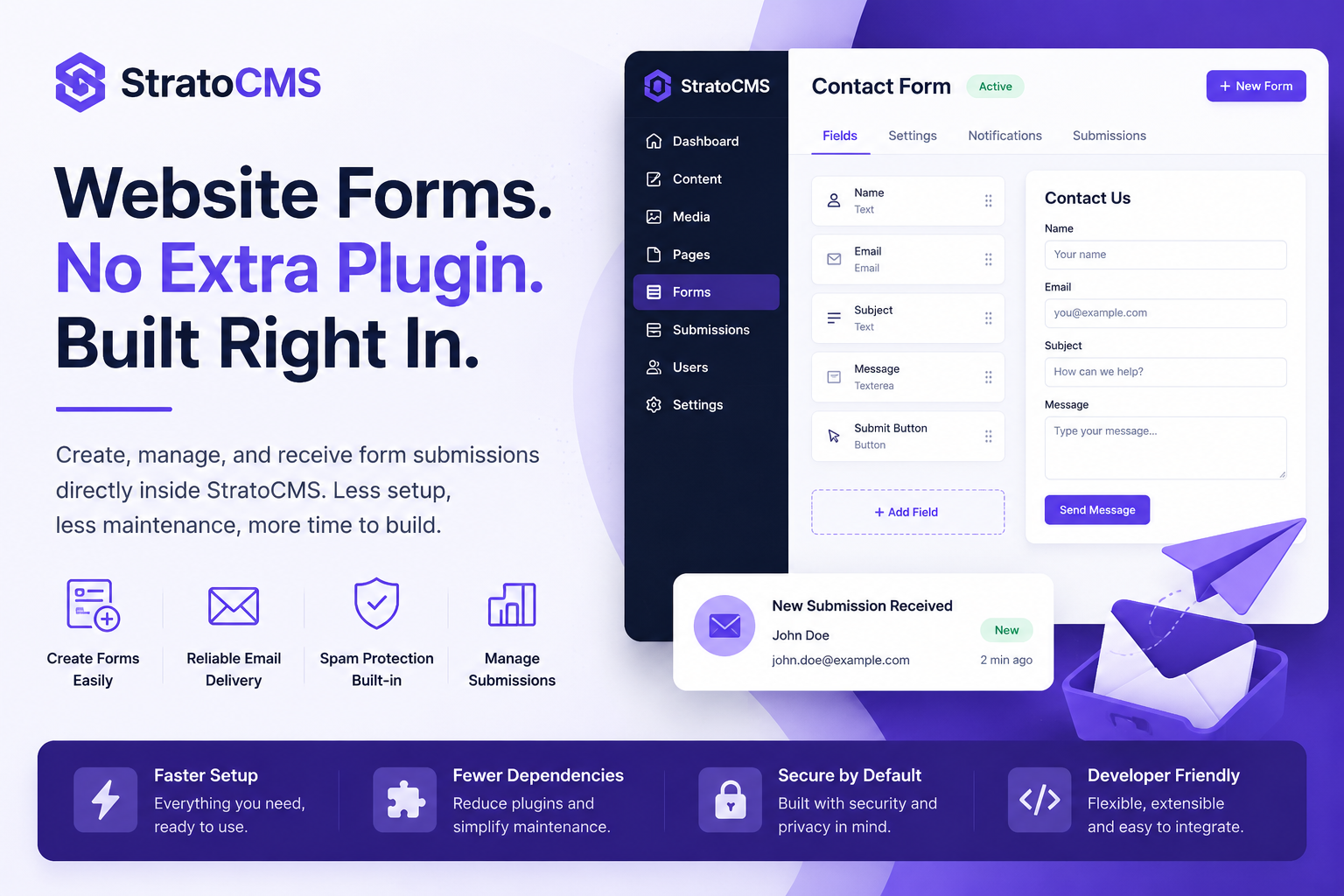
Why Managing Website Forms Shouldn’t Require Another WordPress Plugin
Contact forms are one of the most basic requirements of a modern website.
A visitor wants to ask a question, request a quote, contact support, apply for a position, or simply get in touch.
It sounds simple.
But on many WordPress websites, adding a form means adding another plugin — and sometimes several additional services around it.
The Traditional WordPress Form Setup
When building a WordPress website, forms are commonly handled through third-party plugins.
Depending on the requirements, you may need to:
Install a form builder plugin
Configure SMTP or another email delivery service
Manage spam protection
Configure form notifications
Handle form submissions
Keep the plugin updated
Check compatibility with WordPress and other plugins
Purchase premium extensions for advanced functionality
None of these tools are necessarily bad. In fact, the WordPress ecosystem offers some excellent form solutions.
The question is different:
Should something as fundamental as receiving an enquiry always require another plugin?
Essential Features Should Feel Native
At StratoCMS, we believe frequently used website functionality should be considered as part of the platform experience rather than automatically becoming another dependency.
Forms are a good example.
A modern CMS should make it straightforward to collect information from visitors and manage those submissions without forcing developers to assemble multiple pieces before a basic contact form becomes useful.
The goal is simple:
Less configuration. Fewer dependencies. More time building the website.
The Problem Isn't Just the Number of Plugins
Installing one additional plugin may not seem significant.
But websites rarely stop at one.
You may have one plugin for forms, another for cookie consent, another for SEO, another for redirects, another for security, another for caching and several more for individual website features.
Each additional dependency introduces something else that may need:
Updates
Configuration
Security monitoring
Compatibility testing
Troubleshooting
Licensing
Over time, what started as a simple website can become an ecosystem of independent components.
A More Integrated CMS Approach
StratoCMS is being designed around a different philosophy.
Instead of asking developers to immediately search for a plugin whenever they need common functionality, we're working toward providing more essential capabilities as part of the CMS itself.
That creates a more predictable development experience.
Developers can spend less time assembling the foundation and more time creating the experience their website actually needs.
Built-In Doesn't Mean Less Flexible
There is an important distinction.
Reducing plugin dependency shouldn't mean removing flexibility.
Developers still need the ability to build custom experiences, integrate external services and create functionality specific to their projects.
The objective is to provide a stronger starting point.
Common functionality should be simple.
Custom functionality should remain flexible.
A CMS Should Do More Out of the Box
The web development ecosystem has changed considerably since traditional content management systems were first introduced.
Performance expectations are higher.
Security matters more.
Development workflows have evolved.
And businesses expect websites to integrate with many different systems.
We believe the CMS should evolve too.
Instead of beginning every new requirement with:
“Which plugin should we install?”
We want developers using StratoCMS to increasingly find that the essential foundation is already there.
Less Plugin Management. More Building.
Forms are only one example.
Cookie consent, content management, media, users and other everyday website capabilities all contribute to the same philosophy behind StratoCMS:
Give developers a strong foundation without creating unnecessary complexity.
Because building a modern website should be about creating great digital experiences — not maintaining an ever-growing collection of plugins.
Explore StratoCMS:
https://www.stratocms.com/
Performance-first CMS with AI layouts, built-in SEO and ecommerce.