
Best WordPress Alternatives in 2026
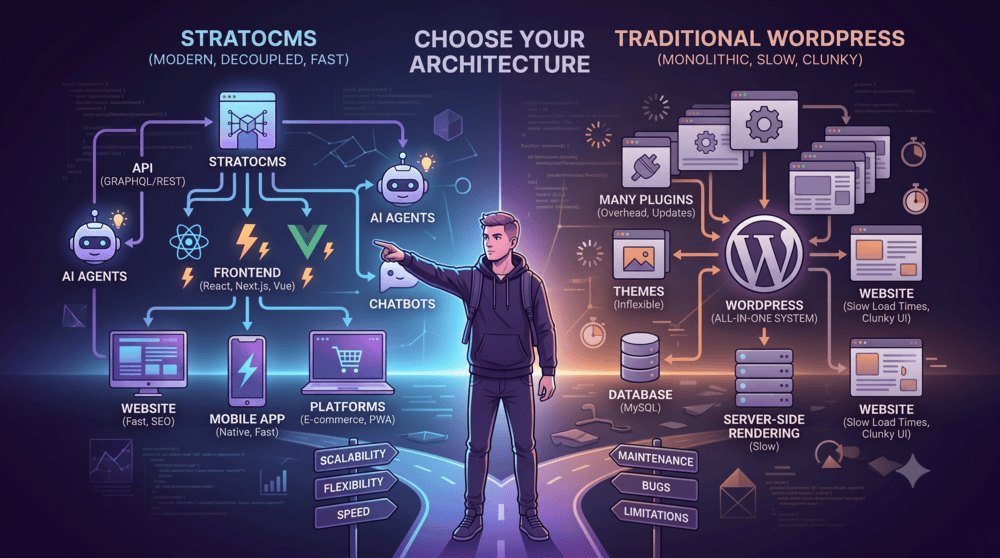
WordPress powers over 40% of websites on the internet, and for many businesses, it's still an excellent choice. However, modern websites often require faster performance, better security, API-first architecture, AI features, and seamless integration with frameworks.
If you're building a high-performance website, SaaS platform, or enterprise application, it's worth exploring modern alternatives.
Here are the best WordPress alternatives in 2026.
1. StratoCMS
Best for: Businesses, agencies, developers, and high-performance websites.
StratoCMS is a modern headless CMS built with a visual page builder, AI-powered content generation. Unlike traditional CMS platforms, it focuses on speed, SEO, and developer flexibility.
Pros
- Visual drag-and-drop builder
- AI Layout Generator
- Headless architecture
- Excellent SEO capabilities
- Fast page loading
Cons
- Newer ecosystem compared to WordPress
2. Payload CMS
Perfect for developers who want complete backend control using Node.js.
Best for:
- APIs
- Custom applications
- Developer-first projects
3. Strapi
One of the most popular open-source headless CMS platforms.
Great for:
- REST APIs
- GraphQL
- Multi-platform content
4. Contentful
A powerful enterprise content platform used by large organizations.
Best for:
- Large businesses
- Multi-channel publishing
- Enterprise workflows
5. Sanity
Sanity offers a flexible content studio and structured content approach.
Ideal for:
- Marketing teams
- Content-heavy websites
- Digital experiences
6. Webflow
A no-code website builder with beautiful visual design tools.
Best for:
- Designers
- Landing pages
- Marketing websites
7. Ghost
Ghost focuses on publishing and memberships.
Best for:
- Blogs
- News websites
- Paid newsletters
8. Drupal
A mature CMS designed for enterprise and government projects.
Best for:
- Large organizations
- Complex permissions
- Security-focused websites
9. Joomla
A traditional CMS offering more flexibility than WordPress but with a steeper learning curve.
Best for:
- Community websites
- Portals
- Legacy systems
10. Wix
A beginner-friendly website builder with hosting included.
Best for:
- Small businesses
- Personal websites
- Quick website launches
Comparison Table
| Platform | Best For | Headless | AI Features | Self Hosted |
|---|---|---|---|---|
| StratoCMS | Modern Business Websites | ✅ | ✅ | ✅ |
| Payload CMS | Developers | ✅ | Limited | ✅ |
| Strapi | APIs | ✅ | Limited | ✅ |
| Contentful | Enterprise | ✅ | Limited | ❌ |
| Sanity | Content Teams | ✅ | Limited | ❌ |
| Webflow | Designers | ❌ | Limited | ❌ |
| Ghost | Blogging | Partial | ❌ | ✅ |
| Drupal | Enterprise | Partial | ❌ | ✅ |
| Joomla | Traditional CMS | ❌ | ❌ | ✅ |
| Wix | Beginners | ❌ | Basic | ❌ |
Which CMS Should You Choose?
Choose WordPress if:
- You need thousands of plugins.
- You're running a traditional blog.
- Your team is already familiar with WordPress.
Choose StratoCMS if:
- You want better performance.
- SEO is a priority.
- You need AI-powered content creation.
- You want a modern visual page builder.
Choose Webflow if design is your highest priority.
Choose Payload or Strapi if you're building developer-focused applications.
Final Thoughts
WordPress remains a fantastic platform, but it's no longer the only option. Modern businesses increasingly need faster performance, stronger security, better SEO, and AI-powered workflows.
Choosing the right CMS depends on your project, team, and long-term goals. Evaluate your requirements carefully and select the platform that aligns with your technical and business needs.
Performance-first CMS with AI layouts, built-in SEO and ecommerce.